Showing posts with label Romania. Show all posts

Wednesday, 20 July 2011

Boooo! Quite Uncool


Before the 1989 Revolution which attempted to put the country back on the democratic track it had been taken off by the Soviet Union, two things were known about Romania by almost anyone abroad: girls’ gymnastics and communism. 

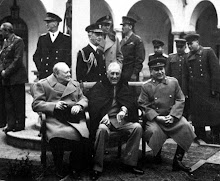
More than 20 years after the collapse of the Soviet Union, here’s a strange rendition of the moment the West united with Russia to decide spheres of influence over that country :-)

When Romania’s girls’ fencing team won the gold in the European Championships in Sheffield, everything seemed to go smoothly. Medals were hung around their necks, little souvenirs handed over... then, at minute 4:35 of this video, the whole team leaves the podium in the middle of the ceremony! Only to be replaced, moments later, by smiling Russian and French girls, silver and bronze medallists. The Russians went as far as to sit on the podium while the Romanians were nowhere to be seen. 


How rude of the Romanians to leave this way, many people are likely to say. But maybe if they knew that the old, communist anthem of Romania was played during the ceremony instead of the one chosen by the country when it got rid of the communist dictatorship at the price of more than 1,000 lives, they’d be more sympathetic.

Sunday, 30 January 2011

What Egypt Could Learn From Romania's Ceausescu


What is happening now in Egypt reminds me in an eerie way of the Romanian revolution in 1989. The internet is already abuzz with speculation that Egyptian president Hosni Mubarak might end up like his late friend, former communist dictator Nicolae Ceausescu, who was executed after a very short trial. It’s all down to what the army will do – will it side with the people or continue to protect an increasingly alienated dictator?

I really hope, for the Egyptians’ sake, that the similarity stops here. What happened in Romania after the revolution and the execution of the Ceausescus is a sad reminder that good times do not necessarily begin once the revolution is won, protesters are back from the streets and the dead are buried. Blaming only one person for the evil that has penetrated a country is an easy, but dangerous path to take.


In 1990, after the Ceausescus were gone and the Communist Party supposedly outlawed, the second ranks of his loathed secret police – the Securitate - quickly became the new ruling elite. Without a law preventing them from taking public office, former Securitate agents, informers and collaborators became politicians and created a powerful network of corruption and influence peddling that has engulfed the country ever since.

There have been various attempts to save the Romanian revolution and return its results to the original intended purpose – an end to the corruption that the communist system had encouraged – but they were all stifled by force, the most famous being the two-month long protest in Bucharest and the subsequent bloodshed caused by the miners’ descent on the capital. 


21 years after Romania’s revolution, corruption is omnipresent in the country, to such an extent that more than 10 percent of the population has emigrated in search of opportunities that are denied to them in their home country. 

Social and economic inequality has deepened, the health system is full of doctors that are so callous they would let patients die unless they receive substantial bribes and many teachers in state schools give grades to young pupils based on the “presents” they receive from pupils’ parents rather than on the pupils’ own knowledge.

On many occasions, employment is subject to bribe giving or “knowing” somebody in the right place, rather than depending on the candidate’s real abilities. The media is made up almost exclusively of local moguls who use the TV channels, newspapers and news agencies they own to blackmail, influence and pressure politicians or companies to do various things that benefit a small and corrupt elite.

Ironically, Romanians are nearly back where they started: 21 years after their own revolution, they don’t have a free media, corruption is as rampant (if not even more) as it was under the communists and the rift between the privileged, ruling elite and its cronies and the anonymous masses who barely make ends meet is deepening. 

Sure, they have freedom of speech and freedom of travel, and they take advantage of both. But I doubt that the more than 1,000 people who died in December 1989 sacrificed their lives so that the survivors can emigrate more easily.

That’s one lesson Egyptians could learn from the Romanians’ experience: once the Cairo revolution is over and Mubarak is out, don’t rely on the new people who come in to reform the system all by themselves. You must always be on guard and ready to defend democracy and the rule of law.

Wednesday, 14 April 2010

Give Herta Mueller a Second Nobel Prize

Why are so many Romanians going abroad? No, not everybody is after the money and the "easy" life. Some of them leave because they have no choice. And I'm not speaking here about the Roma who can't find work and hope that they will in the richer West.

I'm talking about the ones who are still, 20 years after the 1989 revolution, fleeing the loathed secret police, the Securitate.

Nobel prize winner Herta Mueller, an ethnic German writer born in Romania, who left the country in 1987, at the height of the communist dictatorship, explains:

"I know that in Romania, scores of people who used to work for the Securitate are now in high-level positions and this has virtually no consequences. It is not important for the society," she told EU Observer.

And listen to this:

"These people have gained so much influence that they have managed to almost re-create their old network of power, where they all know and serve each other. It is the second life of the dictatorship. Under different circumstances, organised in a different way. And without ideology. Without Socialism."

Please, give the woman a second Nobel prize! This one, for being able to explain what is wrong with that system, in a nutshell.

Those of you who are still wondering why things are still not working in these countries, why people are still looking for a better life abroad, why those who stay have to give in to corruption, read her words, over and over again.

What she says is that communism is not really dead. It just changed its name to "market economy" and has taken over the private sector as well.

Mueller goes on to suggest that Eastern European countries should not have been so readily accepted into the EU. This is the part where I don't agree with her.

Joining the EU was the best chance these countries actually had (and still have) to see the light at the end of the tunnel.

Those sick of working like slaves in a corrupt system can travel freely and escape the Securitate agents populating companies – and at some point even corrupt managers will realise they need highly-skilled people to advance their businesses and will get rid of incompetents.

Eastern Europeans can now also go to the EU courts when the corrupt justice system in their countries defies logic and common sense by taking absurd decisions that infringe on their freedoms, property and integrity.

The EU's principles of freedom and justice are well known. Too bad Western European companies investing in the East don't always follow them.

It seems that the Romanian saying that "money has no scent" is an international principle. But even those who currently hire the former Securitate agents will realise, at some point, that they aren't getting their money's worth - unless they hire them for the only job they know to do well: backstabbing.

Tuesday, 23 June 2009

Well, they're leaving. Happy now?

The Romanians who had the honour of having their windows smashed and were threatened with death by thugs in Northern Ireland are finally leaving, the BBC reports.


Not to the south of France, like Sir Fred Goodwin, but back to Romania – not a bad country to be in, during the summer. One resident in the Belfast area where these people were living told the BBC the Romanians brought the attacks on themselves. Asked how, he said "they shouldn't be here." Well, now they won't be.


Hopefully their departure will give a massive boost to employment in the region. For the moment I'd advise all Romanian passport holders (or indeed any other people from anywhere in the world) to refrain from visiting Belfast. One never knows.


Of course, the nice priest who offered overnight dwelling to the Romanians in the City Church, as well as the neighbours who organised anti-racism rallies, have remained in Belfast. But I'm sure they would be welcome in Romania, if the thugs haven't run out of bricks.


On a more serious – sombre, even – note, this is bad. It shows that thugs with bricks and death threats can drive people away. I hope other racist groups won't be inspired by this. Or that authorities will find the will and the guts to stop this kind of acts before it's too late.


Tuesday, 16 June 2009

Romanian Immigrants Share Fred Goodwin's Fortune

What do Sir Fred Goodwin (the former boss of Royal Bank of Scotland, if there's anyone on this planet who still doesn't know who he is) and Romanian immigrants have in common?


Both had their homes' windows smashed in the UK. But while Sir Fred now lives in a plush home somewhere in France, recovering from the stress, the Romanian immigrants were forced to flee their houses in Belfast for fear the attacks will be repeated.


The thugs who did this obviously have no jobs to worry about and not a lot of brain, so they did not stop to think that these immigrants, too, are paying taxes.


Of course, it's not their fault these taxes go to plugging up holes in banks' balance sheets instead of going towards creating British jobs – for British people responsible enough not to throw stones.

Thursday, 11 June 2009

Want to get elected? Follow this man's example!

Politicians hungry for votes should take a look at this populist Romanian ex-shepherd, who is now a MEP.

Gigi Becali, a colourful character who made money in the sheep business during communism (when anything one could eat or wear was worth its weight in gold), got elected into the European Parliament despite being charged with false imprisonment. Or maybe because of it, the BBC writes.

So here's the magic recipe for any politician in need of votes: drive a flashy car (a Maybach, preferably), leave it somewhere where it can be easily stolen, have it stolen, then find the thieves, beat them up and lock them away for a few days, then release them after they've signed statements confirming that they had stolen your car.

Then, when the police investigate you for it, tell the press that police are useless and the only way to obtain justice in this world is by carrying it out yourself. Make sure you are photographed with some religious objects in the background and refer often to your belief in Divine Justice and God.

This works better in poor countries with 45 years of communism behind them but hey, this recession seems to be doing its bit to bring the whole of Europe to that level. Mr. Brown, are you reading this?

PS I am looking forward to a meeting between Gigi Becali and Nigel Farage, the UKIP MEP well-known for his anti-Romanian remarks.

PPS Becali is also the owner of football club Steaua Bucharest, and buildings in the Romanian capital are full of grafitti reading "Gigi, get out!". He will, as soon as Romanian police lift the ban on his leaving the country. After all, the man has a job to do in Brussels.

Thursday, 21 May 2009

Romanians and Bulgarians Invade the UK – By the Dozen

Ok, so finally the feared numbers are here, in the open, for everybody to see and be scared by. How many desperate Poles, Hungarians, Romanians, Bulgarians etc snatched British jobs in the first quarter?


Enough to make one go to the pub and down a quick pint, wondering what all the fuss is about.


The latest statistics on immigration from Eastern Europe have been published by the Home Office on May 20 but went largely unreported by the media. How can this be, when these people with their strange accents are, after all, to blame for the sorry state of the British job market?


Well, I am sure the fair, balanced and open-minded media kept silent on these numbers so as not to spark unnecessary panic in the country.


But I will reveal them here, without fear, since very few people are likely to stumble upon this blog anyway.


Applications from workers in Poland, Lithuania, Latvia, Hungary, Slovakia, Slovenia, Estonia and the Czech Republic dropped to 23,000 in the first three months of 2009, compared to 48,755 during the same period in 2008, the Home Office says on its website.


In what regards Bulgarians and Romanians, 4,615 applications for registration certificates have been decided from January to March 2009, of which 3,055 have been submitted by Romanian nationals, according to the Home Office.


Read more on these truly horrifying statistics on the Home Office website.

Monday, 18 May 2009

Democracy? What Democracy?

Apparently, one Danish MEP believes Bulgarians and Romanians aren't as intelligent, being in the south-east of the continent, as their Nordic colleagues in the European Union. Therefore, they should automatically have less votes in the European Parliament – presumably, calculated taking into account the size of their brains, their ability to solve complex mathematical problems or their capacity to learn very difficult languages.


"When I look at the voting rules, I see that countries like Romania and Bulgaria have many more votes than Denmark and Sweden and Finland, and I think - honestly speaking - that we are more clever than they are," Mogens Camre, deputy leader of the Europe of the Nations group in the European Parliament, whose People's Party is part of Denmark's ruling coalition, told RFI.


"We (in western and northern Europe) have much more transparency, democracy, and social welfare. And we don't think that people who did not create healthy societies should decide for us. Countries which we consider old-fashioned, anti-reform, in many cases directly reactionary, have so much influence in Europe."


Honestly speaking, Mr. Camre, when I look at what you just said, I see that given the right circumstances you could become much more of a dictator than Stalin was. Luckily for the Nordic state you represent, the democracy still at work within the EU prevents you from reaching your full potential.


Regarding the creation of healthy societies in these countries – you seem to conveniently forget who allowed communism there in the first place. Here's a hint: read Churchill's Memoirs.