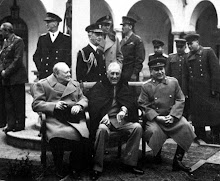
I was talking to a Western friend the other day and he thought I hate Churchill. That’s because I said I consider the British war-time Prime Minister to blame for the 45 years of communism in Eastern Europe, the slavery and the millions of dead in the Gulag and communist prisons. And for the millions more who saw their destiny dictated not by their own abilities, skills or desires but by the whims of the communist “elite” – perpetrators of an alien ideology, imposed upon them by Stalin’s people.
I don’t hate Churchill. But I think he is to blame for this – along with Stalin but obviously much less than him – because of the percentages agreement that he concluded with the Soviet leader on October 9, 1944.
That day, Churchill was in Moscow to discuss the division of Europe after the war was won. It was Churchill who advanced the percentages of influence over Eastern Europe and the Balkans to Stalin. “Let us settle about our affairs in the Balkans” he told the tyrant and then proceeded to suggest who will have what influence in the area.
To people who have lived in those countries, it is remarkable how closely Stalin and his followers have met these requirements. Indeed, the Soviets’ influence – manifested in abuses of human rights, deprivations of freedom, deportations, executions, confiscation of property, various punishments for criticising communism and the smallest attempts to exercise free speech - was divided according to the percentages set out by Churchill in his bit of paper. Romania suffered the worst dictatorship, Bulgaria’s was pretty bad too, Hungary was exposed to a lot of Western influence, Yugoslavia was regarded in the communist bloc as “the West” and so on. After 1989, Bulgaria and Romania were among Europe’s poorest countries – and still are to this day.
I do not hate Churchill at all. I can understand why he sold the Eastern Europeans to Stalin – if he hadn’t, Britons would have probably been forced to learn Russian and the “values” of communism, along with everybody else in Western Europe, in the worst case; in the best case, fighting for the freedom of these people and obtaining a victory against Stalin would have been too expensive for the democratic countries, already weakened by the war.
What I cannot understand is the attitude of people today. Western Europeans – and Britons – largely regard Eastern Europeans as some sort of nuisance, backward little countries who shook off a regime that was conveniently keeping them away from the rich West and who now are “invading” these countries, stealing jobs and welfare and God knows what else. The episode of Gordon Brown being crucified for calling a woman who expressed such a view “a bigot” is well known.
There has been no public condemnation of this infamous agreement, there have been no apologies from Britain and Russia to these people. What happened in Moscow on October 9, 1944 was, in effect, the selling into slavery of millions of people in bulk – and nobody seems to have any recollection of it or remorse for it, in Western Europe.
Back to how I feel about Churchill: he did what he thought was good for his own people, so no, I don’t hate him, but I blame him for what happened to my people during the 45 years of slavery. I used to think that I don’t respect him, either, but actually there is one thing that I respect in him: the fact that he had the courage to tell the world about what he did, in his journal, so that Eastern Europeans know who decided their fate back then.
I just want to make one thing clear: by writing this, all I want is for people in Western Europe to stop and think of history the next time they complain of Eastern Europeans “flocking” into their countries. I know it’s not nice to have lots of poor people coming over looking for jobs. But hey, maybe you owe them your freedom.